
Many organizations have still not fully absorbed the Agile transformation. Teams work in sprints, backlogs are full, daily stand-ups are routine, Jira is everywhere, and yet software delivery often still feels slow, complex, and overloaded.
The real question is therefore not whether Agile was successful or not. The more important question is this:
What happens when the next major transformation in software engineering does not only change how people collaborate, but also changes the division of work between people, machines, and organizations?
This is exactly where we are now with Agentic Engineering.
Agile changed software development profoundly. It changed the rhythm of work, the language of teams, the roles, the expectations around feedback, delivery, and collaboration. Product Owners, Scrum Masters, Sprint Reviews, Retrospectives, and iterative product development have become normal in many organizations. Even where Agile was implemented poorly, it changed the way people think about modern software work.
Agentic Engineering goes one level deeper.
It does not only change how humans organize software development. It changes who or what performs parts of software development.
TL;DR
Agile changed how humans organize software development: more iterative, more collaborative, closer to customer value. Agentic Engineering goes deeper. It does not only change processes and roles; it changes the actual division of work in software engineering. Coding agents can read repositories, modify code, run tests, prepare pull requests, and update documentation.
This shifts the role of developers away from simply writing code toward clarifying tasks, shaping context, reviewing results, guiding architecture, ensuring quality, and governing agentic work. Requirements become more operational, architecture must become more explicit and machine-readable, and tests plus CI/CD gates become the central control layer.
The key lesson from Agile is clear: rituals can be introduced quickly, but real capabilities take time to build. That is why organizations should act early with Agentic Engineering. Those that start learning now, make repositories agent-ready, improve specifications, build governance, and train teams will create a structural advantage.
Agentic Engineering is not just a tool topic. It is a shift in the engineering operating model. Late-moving organizations will not only have to buy licenses later; they will have to catch up on missing learning curves, test maturity, architectural clarity, governance, and skills.
Agile showed that late change is expensive.
Agentic Engineering will show that late learning is even more expensive.
Agile Was an Organizational Revolution
The Agile wave did not come out of nowhere. Lightweight methods such as Scrum, Extreme Programming, Crystal, and others emerged during the 1990s. But the symbolic starting point was the Agile Manifesto in 2001.
At its core, Agile was a counter-movement to heavy, document-driven, plan-driven development models.
Agile introduced a new logic into software engineering:
Do not plan everything upfront. Learn iteratively.
Do not specify for months. Deliver early.
Do not optimize handovers between silos. Collaborate across disciplines.
Do not measure progress only through plans. Measure it through working software and customer value.
For many organizations, this was a fundamental break.
The transformation became even larger when Agile moved beyond individual teams and became an enterprise transformation. From around 2011 to 2015, the major scaling phase began. Frameworks such as SAFe, LeSS, Nexus, and many company-specific models tried to apply agile principles to large organizations, portfolio steering, compliance, architecture work, and environments with hundreds or thousands of people.
The peak of Agile transformation activity probably occurred between 2018 and 2022. During this period, many companies introduced Agile transformation programs, Agile coaches, transformation offices, new role models, new steering mechanisms, and new toolchains. The pandemic accelerated this development further, because digital product development, distributed collaboration, and faster adaptability suddenly became even more important.
But Agile had a limit.
It changed collaboration, but it did not fundamentally change the production function of software engineering.
In the end, humans still had to understand requirements, write code, create tests, analyze bugs, maintain documentation, review pull requests, make architecture decisions, and deal with technical debt.
Agile reorganized human work.
Agentic Engineering starts to execute parts of that work.
Agentic Engineering Is Not Just the Next Copilot
Many organizations underestimate Agentic Engineering because they still see it as a continuation of code completion. That is dangerous.
AI-assisted coding became widely visible with tools like GitHub Copilot. Developers received suggestions directly in the editor. This was useful, but still relatively limited. The AI suggested code. The human decided whether to accept, change, or reject it.
With ChatGPT, starting in late 2022, a second stage became visible. Suddenly, developers could discuss architecture questions, analyze error messages, generate test cases, explain legacy code, or develop refactoring ideas. But this was still largely conversational. The human asked. The AI answered.
Agentic Engineering is the third stage.
Coding agents do not only respond. They can take a task, read repositories, modify files, run commands, execute tests, prepare pull requests, update documentation, and perform work iteratively. The human no longer gives every single instruction. The human defines the goal, context, boundaries, and acceptance criteria. The agent performs parts of the execution.
This may sound like a gradual improvement. In reality, it is a different mode of software work.
The difference is similar to the difference between a navigation system and an autonomous vehicle. A navigation system gives instructions. An autonomous system intervenes in execution.
Software engineering is now crossing that threshold.
Why This Transformation Is Bigger Than Agile
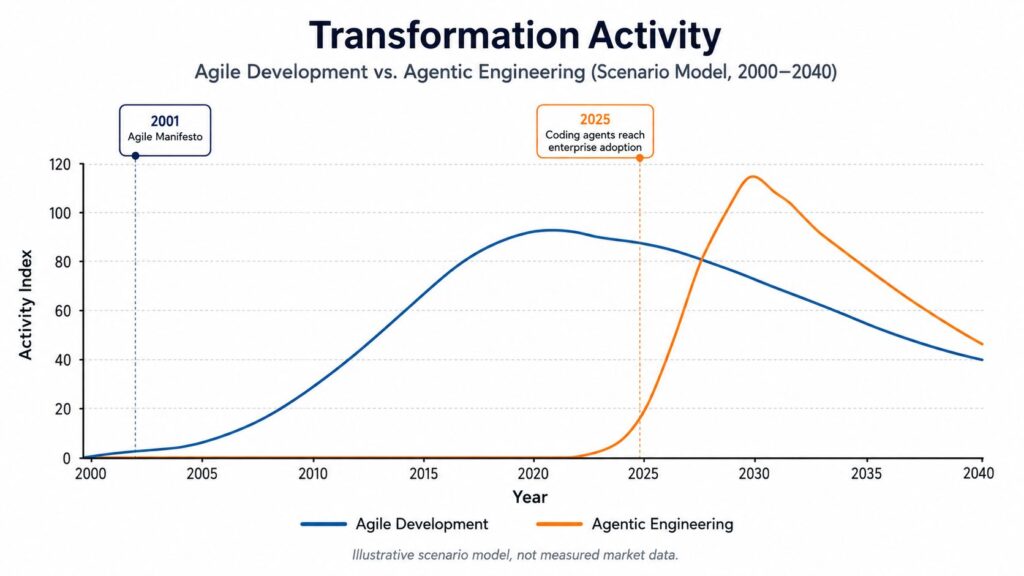
The thesis that Agentic Engineering will be bigger than the Agile transformation is not plausible because AI tools are currently heavily marketed. It is plausible because several layers of the software organization are affected at the same time.
First, the role of developers changes.
The focus shifts from simply writing code toward clarifying tasks, shaping context, reviewing results, verifying behavior, guiding architecture, and controlling quality. Good engineers do not become irrelevant. But their work changes. They must be able to judge whether an agent understood a problem correctly, whether the solution fits the architecture, whether tests are reliable, whether security or compliance risks emerge, and whether the change remains maintainable over time.
Second, requirements engineering changes.
When agents work based on natural language, context files, specifications, and acceptance criteria, requirements become more operational. A specification is no longer just documentation for humans. It becomes input for executing systems. Poor requirements no longer only create misunderstandings between people. They directly lead to poor machine execution.
Third, architecture work changes.
Agents need context. They need to know which modules are critical, which patterns apply, which tests are relevant, which interfaces must remain stable, which security rules must not be violated, and which technical debts have been accepted consciously. Organizations with unclear architecture, outdated documentation, and weak test foundations will not automatically become better through Agentic Engineering. At first, they may simply become chaotic faster.
Fourth, quality assurance changes.
When code can be produced faster, review becomes more important, not less. Tests, static analysis, security scans, policy checks, architecture rules, and CI/CD gates become the real control layer. The organization must not only understand how code is generated. It must understand how agentic work is bounded, checked, and made traceable.
Fifth, governance changes.
With Agile, many questions were about who prioritizes work, who decides in the sprint, and how teams coordinate. With Agentic Engineering, new questions emerge:
Which agents are allowed to access which repositories?
Which actions may they perform autonomously?
Where is human approval required?
How are prompts, context files, and agent configurations versioned?
How do we prevent sensitive data from entering the wrong systems?
How do we audit AI-generated changes?
This is no longer just a methodology question. It is operating model, platform strategy, security, compliance, architecture, and talent development at the same time.
The Agile Lesson: Starting Too Late Is Expensive
Many companies learned too late that Agile is not introduced by sending teams to Scrum training. The visible rituals were easy to adopt. The real change was harder: product ownership, decision-making power, technical excellence, leadership behavior, funding models, portfolio management, and customer proximity.
That is why many companies ended up with agile façades. Teams worked in sprints, but budgets remained project-based. Product Owners were not truly empowered. Architectures remained monolithic. Releases were still difficult. Leadership expected waterfall-style predictability, but called it Agile.
The same mistake is likely to happen again with Agentic Engineering, only faster.
Many organizations will start by buying licenses. They will roll out copilots, coding agents, and AI editors. Some teams will achieve impressive productivity gains. Other teams will spend more time correcting, reviewing, contextualizing, and debugging AI-generated output.
Then the classic management question will appear:
Why does it work in Team A, but not in Team B?
The answer will rarely be the tool.
The answer will be the system.
Agentic Engineering amplifies the existing maturity of an organization. Where architecture is clear, tests are reliable, repositories are well-structured, requirements are precise, DevOps processes are stable, and teams are competent, agents can create enormous value. Where these foundations are missing, agents mainly accelerate uncertainty.
This is the decisive point:
Organizations that start early do not only start with a tool. They start learning.
Why Early Action Matters Even More This Time
With Agile, organizations could wait for a long time and still catch up eventually. The change was large, but it unfolded over many years. Agentic Engineering is likely to move faster because several accelerators come together.
The tools are rolled out through the cloud.
They are integrated directly into IDEs, repositories, and collaboration platforms.
The learning curve of individual teams can be very fast.
The results become visible directly in pull requests, commits, tests, and documentation.
The competitive pressure does not only affect software companies, but every organization that depends on software as a value driver.
Early action does not mean automating everything without control.
Quite the opposite.
Early action means building controlled experience before the pressure becomes too high.
Organizations should now understand which tasks agents can reasonably take over and which tasks they should not. They should clarify which repositories are agent-ready. They should identify pilot areas where value and risk are well balanced. They should define technical guardrails before uncontrolled tool usage spreads. And they should train engineers not only in tool usage, but in agent steering, specification, review, test strategy, context design, and governance.
The biggest mistake would be to treat Agentic Engineering as a productivity add-on for individual developers.
The bigger lever lies in redesigning the engineering system.
What Organizations Should Do Now
First: Develop a clear target picture.
Not every organization needs highly autonomous coding agents in production-critical repositories immediately. But every software organization should have a target picture for how AI-assisted and agentic engineering will fit into its software development lifecycle.
Is the goal legacy understanding?
Test generation?
Bug fixing?
Documentation?
Refactoring?
Migration?
Feature development?
Security review?
Architecture checks?
Without a target picture, tool usage grows without strategic direction.
Second: Make repositories agent-ready.
Agents are only as good as the context they receive and the feedback systems that constrain them. Good README files, architecture overviews, coding guidelines, test commands, local setup instructions, clear module boundaries, CI/CD pipelines, and automated checks become more important.
What used to be implicit team knowledge must now become more explicit, more versioned, and more machine-readable.
Third: Operationalize specifications.
Requirements should be written in a way that both humans and agents can work with them. This means clear acceptance criteria, examples, edge cases, non-goals, quality expectations, security assumptions, and review rules. The old separation between requirements, development, and testing will continue to dissolve. Good specifications become the steering layer of agentic work.
Fourth: Design human-in-the-loop deliberately.
Not every action requires human approval. But critical actions need clear control points.
Which changes may an agent only suggest?
Which changes may it execute?
Which changes may be automatically tested, but not merged?
Where is architecture review required?
Where is security review required?
Where is product approval required?
Agentic Engineering does not need a culture of fear. But it does need a conscious control model.
Fifth: Redefine productivity.
Lines of code, number of pull requests, or velocity are not enough. When agents produce code faster, these metrics can become even more misleading.
More important metrics include lead time, defect rate, review effort, rework, test coverage, deployment frequency, change failure rate, maintainability, and customer value.
Agentic Engineering must not only generate more output. It must create better value.
Sixth: Develop leadership and engineering together.
Agentic Engineering is not only a developer topic. CTOs, CIOs, product leaders, security, compliance, HR, and finance are all affected. The topic touches tool costs, governance, skill profiles, delivery capability, risk management, and competitiveness.
Anyone who delegates the topic only to individual developers will get local experiments, but not organizational capability.
The Real Opportunity
The most interesting question is not whether agents will replace developers. That question is too simplistic and leads to the wrong debate.
The better question is:
Which organizations will learn faster how to redesign software work?
Agentic Engineering can relieve teams. It can make legacy code easier to understand. It can generate tests faster. It can update documentation. It can prepare refactorings. It can take over repetitive tasks. It can create new entry points into complex codebases. It can move experienced engineers toward higher-value work.
But none of this happens automatically.
Without clear architecture, reliable tests, meaningful governance, and skilled people, Agentic Engineering can also create more complexity. It can multiply bad patterns, accelerate technical debt, turn unclear requirements into wrong implementations, and overload review processes.
That is why early action matters.
Not because every hype should be followed.
But because organizational learning curves take time.
Agile showed that methods can be introduced quickly, but capabilities emerge slowly. Agentic Engineering will intensify this lesson. The tools are developing faster than organizations. That is exactly why organizations need to start adapting their structures, processes, and technical foundations now.
Conclusion
Agile moved software development away from rigid project plans and toward iterative, customer-oriented collaboration. That was a major transformation.
Agentic Engineering goes further.
It changes the operational work itself. It makes specifications more executable, repositories into workspaces for agents, tests into control systems, architecture into machine-readable context, and engineering leadership into a question of human-agent collaboration.
Organizations that start early will not only use better tools. They will better understand how their future software value creation works.
Organizations that wait will not simply have to buy licenses later. They will have to catch up on missing learning curves, missing governance, missing test maturity, missing architectural clarity, and missing skills.
The Agile transformation showed that late change is expensive.
Agentic Engineering will show that late learning is even more expensive.