
Evaluate AI use cases: buy, hold or sell?
KI-Depot manages your AI projects like a securities portfolio: with cost basis, expected return, risk and a clear recommendation. You also classify every project under the EU AI Act and see which obligations apply when.
What the tool shows
Steer AI projects as a portfolio, not as a collection of pilots.
Many companies have a dozen AI initiatives but no shared view of value, risk and dependencies. KI-Depot puts them all on one portfolio statement an investment committee can read.
You enter
- +For each project: investment, running costs and expected benefit
- +Probability of success, data maturity and time to impact
- +Vendors, so that dependencies become visible
- +Three questions for the EU AI Act classification, and your role
You get
- →Portfolio statement with Buy, Hold, Watch or Sell
- →Risk-return chart of the portfolio and concentration risk per vendor
- →Classification per project: prohibited, high risk, transparency, minimal
- →AI Act obligations calendar and a paper for the investment committee
Method
How KI-Depot calculates.
Every figure can be traced. The tool gives the formula for every number; here are the most important ones.
Calculation
- +Expected annual value = benefit × probability of success × data maturity factor
- +Return over 3 years = net gain ÷ investment
- +Risk score from AI Act class, data maturity and vendor dependency
- +Concentration risk from a 40% share of one vendor or a concentration index above 0.25
Assumptions and limits
- →Deadlines after the Digital Omnibus, Regulation (EU) 2026/1744
- →High risk under Annex III from 2 December 2027, Annex I from 2 August 2028
- →Conservative: “unsure” counts as “yes” until the question is settled
- →As of October 2026, not legal advice
Example
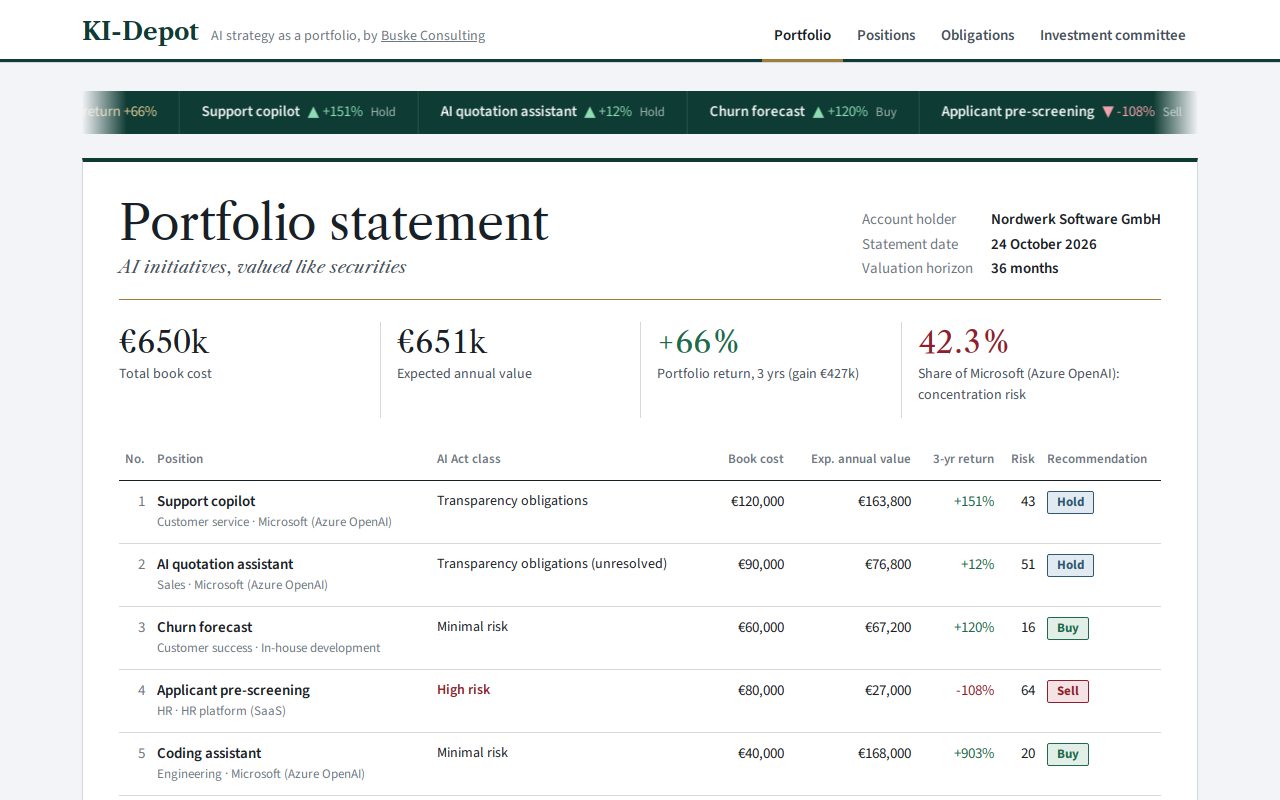
Example: 66% return, but one vendor holds 43%.
The fictitious Nordwerk Software GmbH holds nine AI projects in its portfolio, a cost basis of around €650k and an expected return of 66% over three years. The code assistant and invoice recognition are Buy. Applicant pre-screening is high risk under Annex III and does not pay off: Sell. Microsoft accounts for 43% of the investment, a concentration risk.
Frequently asked questions
Questions about KI-Depot.
How do I evaluate AI use cases?
By expected value, cost, risk and dependencies, all by the same logic. KI-Depot calculates the expected annual value, the return over three years and a risk score, and derives a recommendation from them.
When do the obligations for high-risk AI apply?
After the Digital Omnibus (Regulation (EU) 2026/1744), the obligations for high-risk systems under Annex III apply from 2 December 2027 and under Annex I from 2 August 2028. Prohibitions and AI literacy have applied since February 2025.
Does the classification replace a legal review?
No. The classification assistant is deliberately conservative and shows where you should look more closely. For high-risk projects or those with an unclear classification, KI-Depot recommends a legal review.
Who sees my figures?
Nobody but you. KI-Depot calculates entirely in your browser, with no server and no sign-up.
What is a high-risk AI system under the AI Act?
An AI system used in one of the areas listed in Annex III, such as recruitment, creditworthiness or critical infrastructure, or one that serves as a safety component of a product under Annex I. Obligations on risk management, data, documentation and human oversight apply to it.
What is concentration risk with AI vendors?
Dependence on a few vendors. KI-Depot flags it as soon as one vendor accounts for at least 40% of the investment or the concentration index exceeds 0.25.
From portfolio statement to AI strategy.
In a free 30-minute initial call we review your assumptions and discuss how the self-assessment becomes a reliable diagnosis.