
Tech due diligence as a self-assessment: your rating from AAA to D.
Tech-Rating rates your technology the way a rating agency rates a company: a rating, an outlook, the factors behind it and the shortest path to the next notch. 28 questions, about 15 minutes, no sign-up.
What the tool shows
A rating investors and boards understand at once.
Before a funding round, a sale or an investment decision, investors and boards ask about the state of the technology. Tech-Rating gives you in advance the answer a due diligence would likely give, and shows what it hinges on.
You enter
- +Company stage: start-up, scale-up, mid-market or carve-out
- +28 questions on architecture, delivery, team, security, data and operations
- +Delivery metrics following DORA
- +Three questions on recent development for the outlook
You get
- →Rating from AAA to D with a positive, stable or negative outlook
- →Rating factor assessment and the strongest rating drivers
- →Upgrade path: the fewest steps to the next notch, with effort
- →One-page rating report in the style of an agency
Method
How Tech-Rating calculates.
Every figure can be traced. The tool gives the formula for every number; here are the most important ones.
Calculation
- +Score = weighted factor scores; weights depend on company stage
- +21 notches from AAA to C plus D; investment grade down to BBB−
- +Knock-out criteria cap the rating, such as untested backups or a key person
- +The upgrade path searches all combinations of up to four improvements
Assumptions and limits
- →Unanswered knock-out questions make the rating provisional
- →Displayed scores are truncated, never rounded up
- →A better answer never lowers the rating
- →A self-assessment, not a certified rating
Example
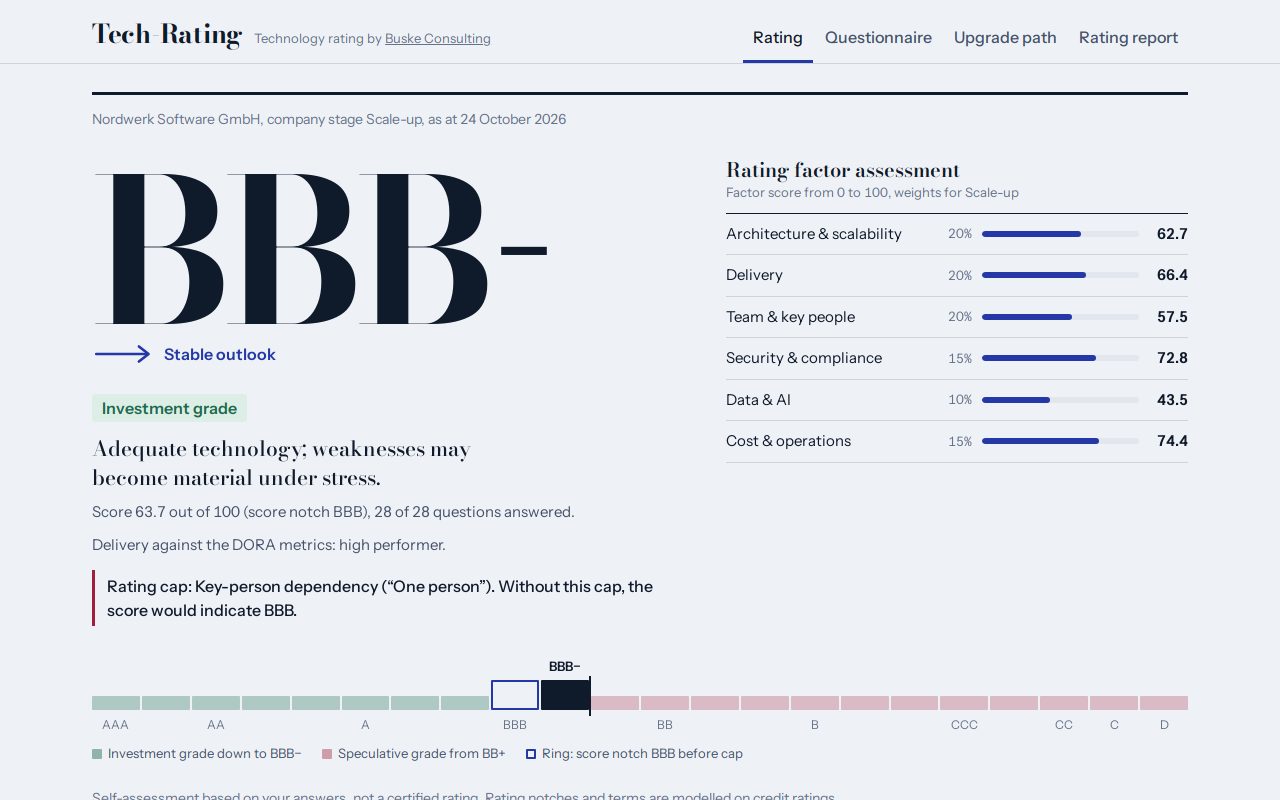
Example: BBB−, outlook stable.
As a scale-up, the fictitious Nordwerk Software GmbH reaches a score of 63.7, which would mean BBB. Because only one person understands the billing core, the key-person dependency caps the rating at BBB−, just still investment grade. The upgrade path shows: resolving this one dependency lifts the rating by one notch.
Frequently asked questions
Questions about Tech-Rating.
What does a tech due diligence examine?
Architecture and scalability, the team’s delivery capability, dependence on key people, security and compliance, data and AI, and cost and operations. Tech-Rating covers these six factors with 28 questions.
How meaningful is a self-assessment?
It reliably shows where the biggest risks lie and which knock-out criteria apply. An external due diligence also examines code, systems and interviews, and therefore reaches a robust verdict.
What does investment grade mean?
As with credit ratings: BBB− and better. Below that the technology counts as speculative, a risk an investor would reflect in the price or in conditions.
Who sees my answers?
Nobody but you. Tech-Rating calculates entirely in your browser; you can save your answers as a file.
When is a tech due diligence worthwhile?
Before a funding round, a sale or acquisition, and before large investments in technology. A self-assessment beforehand shows which questions investors will ask and where you should do some work first.
What are knock-out criteria in Tech-Rating?
Individual shortcomings that cap the rating regardless of the overall score, such as untested backups or a key person without whom a core system cannot be developed further. As with credit ratings, a single risk caps the rating.
From self-assessment to a robust due diligence.
In a free 30-minute initial call we review your assumptions and discuss how the self-assessment becomes a reliable diagnosis.