
Four Observations on Tech Leadership in 2027 · Part 1 of 4: Strategy, Not Just Technology
80% of surveyed CEOs say technology has become part of strategy itself. Yet many companies still struggle to demonstrate a financial return on their AI investments. Both findings come from the same Gartner survey, published in October 2026. [1]
Together, they capture the changing role of the CTO remarkably well. Technology decisions are no longer made only after the business strategy has been defined. Technology increasingly determines which strategic options are available in the first place. The real test, however, is turning those options into measurable value.
Four Observations on Tech Leadership in 2027
In this four-part series, I examine developments that are reshaping technical leadership. Each article focuses on one observation:
- Strategy, not just technology: The CTO’s mandate now extends further into business models, AI value creation and organizational change.
- Technical leadership still involves technical work: Engineering leaders are balancing strategy, architecture and hands-on engineering.
- Agents are becoming part of the engineering organization: Tasks, decision rights and control points need to be redesigned.
- The talent and skills challenge: How do we develop strong engineers when AI takes over more routine work?
This first article looks at the CTO’s strategic responsibilities, drawing on recent findings from EY-Parthenon (October 2026), Gartner (October 2026) and PwC (November 2026).
TL;DR
- Technology is now a board-level strategic issue. According to Gartner, 80% of surveyed CEOs see technology as part of strategy itself, while 44% struggle to demonstrate financial returns from AI. [1]
- The CTO mandate is expanding in concrete ways. In EY’s 2026 survey, 62% of 400 European software CTOs report that responsibility for AI product roadmaps has been added to or expanded within their remit. [2]
- Organizational readiness is lagging. In PwC’s EMEA CIO Survey 2027, 38% expect to lead enterprise-wide transformation within 18 months, but only 5% believe their organizations are ready. [3]
- The yardstick is changing: Strategy, architecture and AI adoption must contribute to business value, risk management and long-term adaptability—not just project progress or the volume of code generated.

Figure 1: The CTO as a bridge between technological possibilities and business decisions. Original AI-assisted illustration, 2026.
Technology Is No Longer Just a Means to an End
Not so long ago, a technology roadmap could be developed largely on its own terms: migrate to the cloud, modernize the ERP system, build a new data platform, improve software delivery processes. Business leadership set the goals, and the technology organization supplied the capabilities.
That picture is increasingly incomplete.
AI may enable a software company to create entirely different products, enter new markets or see features it previously sold under a license become commodities. An industrial mid-sized company may use agents to redesign business processes that previously required extensive custom development. And an architecture decision can determine how dependent a business becomes on a particular platform provider.
These are not matters to hand off to IT after the business decision has been made. They are business decisions—with a substantial technical component.
The Gartner 2027 CEO Survey, published on October 20, 2026, and based on 203 CEOs and senior executives, illustrates this shift:
- 80% see technology as part of business strategy itself.
- 75% plan to increase technology investments.
- 44% struggle to demonstrate financial returns from AI to stakeholders.
- 63% identify fundamental operating-model redesign as an important measure for improving financial returns from AI by 2027. [1]
What matters is the combination: technology is becoming more strategically important, yet many organizations still struggle to convert that importance into demonstrable value.
What European CTOs Are Actually Responsible for in 2026
For Beyond the Code: How AI Is Redefining the Software Industry, EY-Parthenon and Potloc surveyed 400 CTOs at European software companies across 13 countries in June and July 2026. [2]
This study is particularly useful because it does more than ask what CTOs expect to happen. It also examines which responsibilities have already been added to or expanded within the CTO mandate.
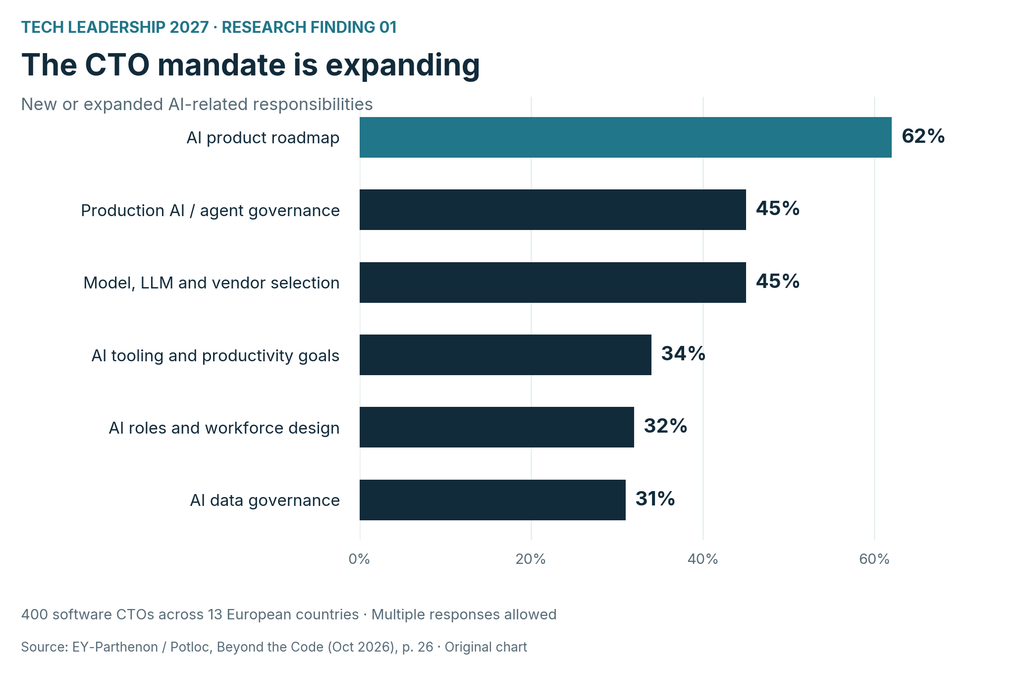
Figure 2: New or expanded AI-related responsibilities among software CTOs. Multiple responses permitted; 400 CTOs surveyed. Source: EY-Parthenon/Potloc, Beyond the Code (2026), p. 26; original visualization. [2]
62% report expanded responsibility for AI product roadmaps. 45% each point to production AI/agent governance and the selection of AI models and vendors. AI tooling and productivity targets, workforce and role design, and AI data governance are also being added to the job.
That is a substantial shift. The CTO is no longer responsible only for building a high-performing engineering organization. Increasingly, the role also involves deciding which AI capabilities the company develops, how those capabilities are governed and how they fit into the business model.
Precision matters here, too. The study does not suggest that CTOs suddenly own everything. Primary decision rights for customer-facing AI product features often sit with product leadership; the CISO remains a key decision-maker for AI security. Technical leadership is therefore becoming more cross-functional, not a one-person mandate.
The Real Gap: Ambition Versus Capability
A second study shows why a broader mandate, by itself, is not enough.
The PwC EMEA CIO Survey 2027 was released on November 9, 2026. Between July and September 2026, PwC surveyed 705 technology executives from 22 countries in Europe, the Middle East and Africa, including CIOs and CTOs. [3]
38% expect to lead enterprise-wide transformation within the next 18 months. Just 5% believe their organization is ready. At the same time, only 6% say AI spending can be directly linked to business value.
Perhaps the most telling figure for the CTO’s strategic mandate concerns performance measurement. According to PwC, only 16% of technology organizations are currently assessed primarily on business outcomes. Respondents expect that share to reach 33% within the next 18 months.
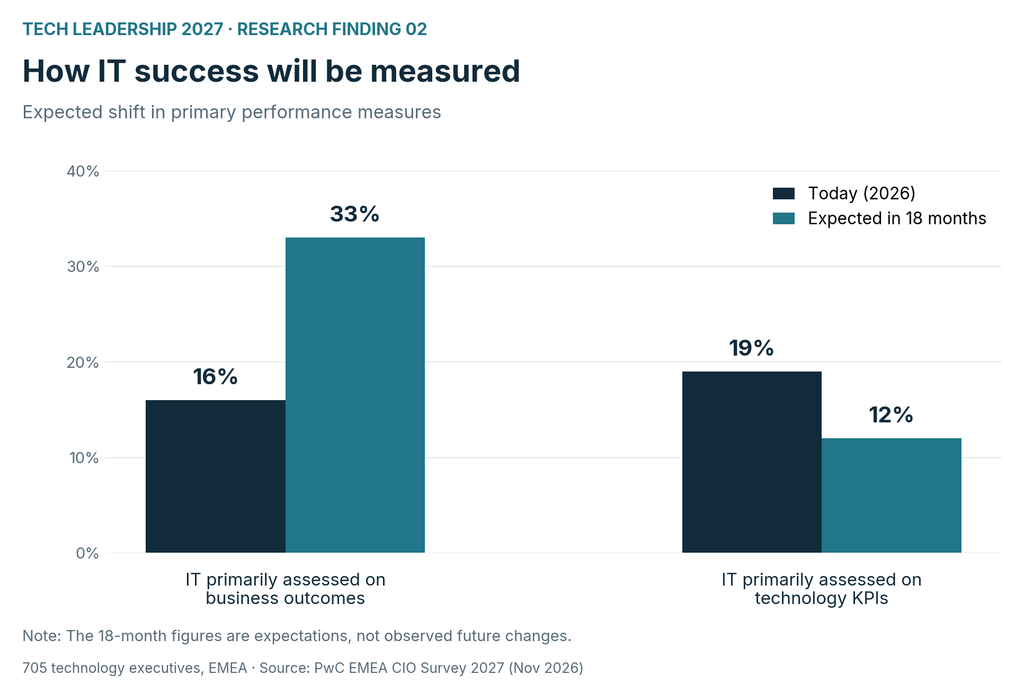
Figure 3: How respondents expect the primary measures of IT performance to change. The 18-month figures are respondents’ expectations, not observed future outcomes. The chart shows two selected categories, not the full distribution. Source: PwC, EMEA CIO Survey 2027 (November 2026); original visualization. [3]
To me, this highlights one of the biggest leadership challenges heading into 2027: You cannot create accountability for business value merely by adding a line to a job description. You need decision rights, shared priorities, suitable metrics and an operating model that can actually deliver change.
What “Strategy, Not Just Technology” Means in Practice
A strategic CTO does not need longer strategy presentations. They need better answers to a few fundamental questions.
1. What Business Problem Are We Actually Solving?
“We want to introduce agentic engineering” is not yet a strategy. “We want to shorten the time from a customer request to a usable production feature without increasing security or maintainability risks” is a clear strategic objective.
The same applies to cloud platforms, data infrastructure and modernization. Any technology initiative should be justified in terms of growth, costs, customer experience or resilience.
2. Which Technology Options Are We Creating—or Closing Off?
Technology strategy is also about preserving future freedom of action. When we choose a model, platform or proprietary data stack, can we change direction later? What would switching cost? Which architectural choices will let us introduce new products or processes without rebuilding everything each time?
With AI, model capabilities, costs and vendors are changing particularly quickly. Flexibility can therefore have economic value of its own.
3. What Does Technical Debt Cost Our Business?
Technical debt is not simply an internal list in the engineering backlog. It can slow product development, make integrations more expensive, increase risk or delay entry into new markets.
The leadership task is to evaluate it in business terms: Which debt costs us time or money every month? Which debt constrains growth? Which debt can we deliberately leave in place without putting our future options at risk?
4. Who Owns the Value of an AI Investment?
An agent might save 30% of the time spent on an activity and still generate no meaningful business benefit. Perhaps the bottleneck merely moves to quality assurance. Perhaps integration and operating costs rise. Or perhaps there is not enough demand for the product being developed faster.
According to the Gartner CIO and Technology Executive Agenda 2027, just 13% of the 2,002 technology executives surveyed say their organizations have already realized significant or transformational value from AI. [4]
Gartner therefore recommends, among other things, defining explicit stopping criteria for AI pilots and production applications. That is a management discipline: do not just launch initiatives; know when an approach is failing to deliver the value promised.
5. Is Our Operating Model Ready for the New Mandate?
A CTO cannot lead strategically in isolation if budgeting, product prioritization, architecture decisions, governance and delivery still operate in separate silos.
In an agent-enabled organization, for example, Product, Engineering, Security, Data and Finance need to agree on where agents can be used, which actions they are authorized to take and how their contribution will be assessed.
It is therefore telling that EY’s 2026 survey identifies AI governance, product roadmaps and workforce design as expanding areas of CTO responsibility.
Agentic Engineering Makes the Strategy Question More Urgent
Coding agents can now independently handle parts of software development: searching repositories, implementing changes, running tests and preparing results for review. This changes the economics of software production.
The new EY study also shows where freed-up capacity goes. 56% of CTOs report reinvesting time gained into quality assurance and code reviews, 55% into new features and roadmap initiatives, and 45% into modernization or refactoring. [2, pp. 16–18]
That tells us more than a simple comparison of whether a coding agent is faster than a developer. Productivity is not created merely by accelerating individual tasks. It is created when the organization as a whole delivers better outcomes.
What does this mean for CTOs?
Alongside architecture and engineering, they need to make even more deliberate choices about where additional development capacity should go, how automated work will be verified and which new product or business opportunities become viable as a result.
I explored the implications for engineering organizations in an earlier article: “Agentic Engineering: Warum diese Transformation größer wird als Agile” (in German).
Five Questions for the CTO Agenda in 2027
To assess your own mandate, start with five questions:
- Business value: Can we explain our three largest technology investments in terms of expected business outcomes—not just technical necessity?
- Decision rights: Is it clear who makes decisions on AI product roadmaps, architecture, security, data and agent autonomy?
- Investment economics: Do we account for integration, human review time, rework, operations and risk, as well as license and model costs?
- Organizational capability: Do Product, Engineering, Finance and Security share goals and have sufficiently short decision paths?
- Performance measurement: Do our metrics show whether technology improves customer value, growth, efficiency or resilience—not merely how much we ship?
These questions will not solve a transformation on their own. But they make it clear whether an organization has a technology roadmap—or a technology strategy.
Conclusion: The CTO Must Turn Technology into Value
The biggest change in the CTO role heading into 2027 is not that technical expertise matters less. Architecture, platforms, engineering quality, security and operations remain the foundation of responsible leadership.
What is changing is how directly those decisions are connected to business models, value creation and organizational transformation.
From different angles, the Gartner, EY and PwC studies reveal the same tension: Strategic expectations are rising. The mandate is expanding. But the ability to consistently translate technology investments into business outcomes is not keeping pace everywhere.
That leads me to a simple leadership question:
Not: Which technology should we introduce next? But: What does our business need to be better at next—and which technology, architecture and organization will make that possible?
In Part 2, I will look at a seemingly contradictory observation: why engineering leaders are moving closer to hands-on technical work even as their strategic responsibilities increase—and where the limits lie.
FAQ: The CTO Role in 2027
How Is the CTO Role Changing in 2027?
CTOs are becoming more involved in product strategy, AI transformation, governance, business value and organizational development. This is particularly evident in EY-Parthenon’s 2026 CTO survey, with additional context from Gartner’s and PwC’s broader technology leadership research. The exact remit varies by organization and industry.
Why Does a CTO Need to Think Strategically?
Because technology decisions directly influence business models, cost structures, risk, growth opportunities and a company’s ability to adapt. Strategic thinking means connecting technological options with business objectives and investment decisions.
What Is the Difference Between a CTO and a CIO?
Broadly speaking, CTOs often focus on technology within products, innovation and engineering, while CIOs frequently own internal enterprise IT and its operation. In many organizations, the mandates overlap. That is why the CIO-focused studies cited here complement, rather than replace, the CTO-specific EY research.
How Does Agentic Engineering Affect Tech Leadership?
Agentic engineering changes not only the speed of individual development steps but also how work is delegated, who is accountable, how quality is verified and how investments are evaluated. The CTO needs to determine what may be delegated, within which boundaries, and how the value delivered by the whole organization will be measured.
How Can a Technology Organization’s Business Value Be Measured?
A useful measurement system combines product and business outcomes with delivery performance, quality, risk and economics. Depending on the objective, relevant metrics might include time to value, product adoption, cost per business transaction, process cycle time, change failure rate or modernization costs. AI usage metrics or code output alone are not enough.
Does “Strategy, Not Just Technology” Mean CTOs Should Be Less Hands-On?
No. Technical judgment remains essential for assessing architecture implications, feasibility and risk. What expands is accountability for priorities and business outcomes—not a reason to abandon technical understanding.
Sources and Methodological Notes
[1] Gartner (October 20, 2026): Gartner Says 44% of CEOs Struggle to Demonstrate AI Financial Returns as Technology Becomes Central to Growth. 2027 CEO Survey, n = 203 CEOs and senior executives, conducted April–May 2026. Findings reflect perceptions, priorities and plans, not causal evidence of AI returns.
[2] EY-Parthenon / Potloc (October 8, 2026): Beyond the Code: How AI Is Redefining the Software Industry (PDF), especially pp. 16–18, 26 and 40. n = 400 CTOs from European software companies across 13 countries, surveyed June 16–July 10, 2026. Figures for new or expanded CTO responsibilities allow multiple responses and refer specifically to the surveyed software industry.
[3] PwC (November 9, 2026): EMEA CIO Survey 2027 – Leading Beyond Technology. n = 705 senior technology executives from 22 countries, including CIOs and CTOs, surveyed July 10–September 6, 2026. Performance measurement figures for “in 18 months” are respondents’ expectations, not observed changes.
[4] Gartner (October 19, 2026): Only 13% of CIOs Say Their Enterprise Has Realized Significant or Transformational Value from AI. 2027 CIO and Technology Executive Agenda, n = 2,002, surveyed May–July 2026. Self-reported business value, not an independent ROI audit.
Further reading: Kyndryl Readiness Report 2026–27, based on 3,700 business and technology executives across 21 countries. The study provides additional context on organizational readiness, transformation and technology integration challenges; it is not a source for the charts above.
Methodological note: These studies cover different populations (CEOs, software CTOs and broader technology leadership groups). Their percentages should not be combined. Consulting and vendor surveys can indicate trends but do not, on their own, establish causal effects on productivity or business value.
Buske Consulting supports organizations with technology strategy, tech due diligence and transformation, as well as interim and fractional CTO engagements.